
PSTN Switch-Off: Why Waiting is Not an Option

The UK’s phone network is going fully digital. Public Switched Telephone Network (PSTN) lines and Integrated Services Digital Network (ISDN) services will be permanently switched off on 31 January 2027. After this date, every UK phone line will run on a fully digital, IP-based network. It’s a fundamental infrastructure change that affects every business running legacy PSTN and ISDN services in the UK.
The PSTN switch-off might feel far away, but the reality is very different; your business may have less time to prepare than you think. Ofcom’s deadline is fast approaching, and the date is fixed, it’s not just a guideline. BT and other providers have already started to decommission exchanges on a rolling basis, postcode-by-postcode. As a result, clients who assume they have until 2027 could find their local exchange goes dark much earlier than anticipated.
Migrating your phone system is not an overnight job, and if you act now, your business will be in a far better position compared to those who wait until the last minute.
What is the PSTN Switch-Off?
The PSTN has been the backbone of the UK’s communications network for many years, with some parts dating back to the Victorian era. Due to the ageing and failing lines, the PSTN and ISDN infrastructure can no longer support modern communications. Providers have stopped investing in expensive maintenance, and fault resolution times are increasing, as replacement parts are no longer available.
For this reason, the PSTN will be switched off on the 31 January 2027. This means traditional analogue lines, ISDN services, and any equipment relying on them will stop working past the switch-off date.
Businesses that still use legacy lines are currently experiencing more downtime even before the official switch-off happens. Ofcom reported in its recent Connected Nations UK Report that the number of PSTN resilience incidents has risen by 45%, highlighting the need for an improved network.
The PSTN switch-off replaces these ageing lines with digital technology, meaning every phone call made in the UK will travel over the internet instead of copper wire.
Does the PSTN Switch-Off Just Impact Desk Phones?
No, most businesses don’t realise how exposed they are. The PSTN touches parts of your infrastructure that aren’t always obviously phone related. These include:
- Fax machines
- Lift alarms
- Fire alarm monitoring
- CCTV
- Door entry systems
- PDQ/payment terminals
Each of these systems will require an individual migration plan to ensure continuity. Discovering these additional dependencies mid-migration or after the switch-off would be expensive and cause legal and safety issues. Therefore, it's important to assess the systems within your business that depend on a PSTN connection and migrate them to a digital service without delay.

How Long Does Migration to a Digital IP-based Network Take?
Migration away from PSTN to a digital alternative will depend on the size of your business, how complex your network is and the service that you choose. A planned migration can take weeks or months if your systems are complex.
The crucial first step is to comprehensively audit all your phone lines and identify each system that relies on PSTN services. Once you have completed this audit, your communications partner can provide a realistic migration timeline and plan for your business’s telephony and supporting services.
If you have no plan in place, you will experience an emergency migration. Businesses that wait until the last minute won’t have the luxury of choosing a suitable cloud solution; they’ll have to accept whatever is available, at pace. Rushed migrations mean poor configuration, inadequate staff training, and disruption to customer-facing operations.
Will a Bottleneck Occur Closer to the PSTN Switch-Off Date?
At the start of 2026, Openreach warned that over 500,000 businesses were still using legacy phone systems and must migrate before the 31 January 2027 deadline.
Leaving your services migration until the last minute could mean you miss the deadline to move to cloud-based technology. Suppliers are likely to have a backlog of requests, and your Managed Service Provider (MSP) may lack the resources to complete your migration in time, as earlier requests will be prioritised.
Securing a port date to migrate your lines will become difficult, as this is done on a first-come, first-served basis. Special port requests may be delayed due to limited availability, particularly if you require out-of-office hours or call diverts. You will need to inform your MSP well in advance of the switch-off to secure a date.
To avoid bottlenecks, your business shouldn’t delay its migration, as this could increase the risk of issues and costly communication downtime.
Will Early Migration to a Digital IP-based Network Give Us a Competitive Edge?
If you’re still deciding when to upgrade, your competitors are already operating on flexible, feature-rich cloud platforms, with unified communications, remote working capabilities, call analytics, AI assistants and CRM integration. Every month spent on legacy lines is a month lost in productivity and enhanced customer experience.
By acting proactively, your business can secure a competitive advantage over those unprepared for the switch-off. Moving to digital before the 31 January 2027 PSTN switch-off deadline will help you avoid bottlenecks, lengthy waits, and potential equipment shortages.
What Will the PSTN Switch-Off Cost My Business?
There’s a widespread misconception about cost when we talk to clients about making the switch. Many believe that inaction is free, but in reality, it isn’t. The real cost comparison you should consider is:
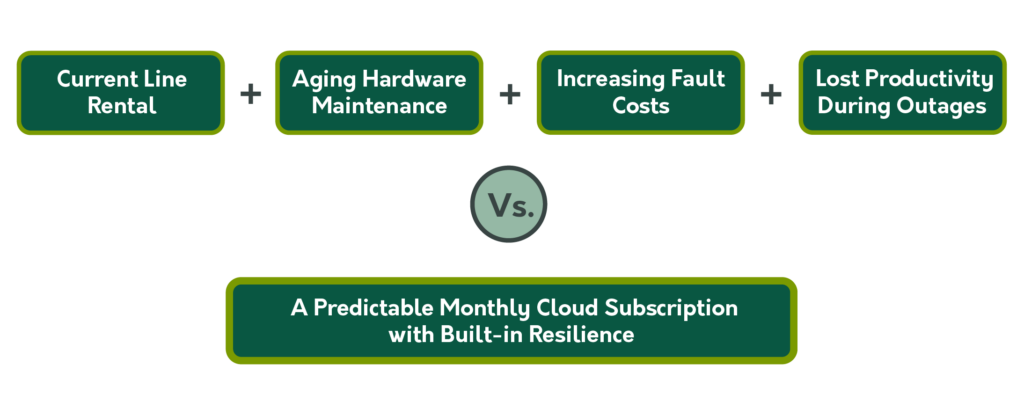
You should also be aware that BT price increases for legacy services will take effect on 1 April, 1 July, and October 2026, which could potentially double your costs.
If your business misses the upgrade deadline, your phones and other PSTN-dependent systems will no longer function. This means systems such as fire alarms, lift phones, payment terminals, and other essential services could stop working overnight. This wouldn’t be a minor inconvenience but a serious critical business failure with major safety, legal, and financial consequences.
Additionally, ISDN/PSTN contracts may auto-renew, and existing hardware (such as PBX systems and handsets) may not work on cloud platforms without upgrades. The longer you wait, the greater the risk of costly renewals you may need to break.
Avoid the PSTN Rush and Move to Seamless Communications with Croft
Businesses are advised to act sooner rather than later to ensure a smooth, risk-free migration ahead of the 31 January 2027 PSTN switch-off deadline. We are advising our clients to provide confirmation of their migration by the 31 August 2026 to avoid costly downtime and disruption.
If you embrace the switch-off as a strategic opportunity rather than an inconvenience, your business can emerge better connected, more resilient, and increasingly competitive.
Ready to Move Away from PSTN? Let Croft Manage Your Migration Ahead of the Switch-Off
If your business is serious about maintaining continuity and capability ahead of the PSTN switch-off, contact our communications experts today.
Whether you’re a small business or large enterprise, we can discuss your connectivity options and identify the right service to replace your existing setup.
Our dedicated PSTN switch-off page and PSTN switch-off eGuide outlines our proactive approach to migrating your telephony services.


Joanna Williams
As a member of the design and marketing team at Croft, my work focuses on developing marketing materials, crafting compelling copy, and managing our website. I joined the team at Croft just over a year ago, bringing with me 13 years of experience in the IT industry.